
Synthetic vs. Mineral Lubricants: A Technical Comparison Beyond the Marketing
The phrase synthetic oil gets used as a badge more than a specification. Everyone knows synthetics are supposed to be better, but few explanations go past the label to say why, or when the difference actually matters. For a maintenance manager or a buyer weighing the price gap, that is the question that counts. Let’s compare the measurable properties of synthetic vs. mineral oil to understand what gives synthetics an advantage, and when those differences matter.
Start with the Base Oil
The real difference is not in the additive marketing. It is in the base oil, which makes up the vast majority of any finished lubricant. Mineral base oils are refined from crude petroleum. Refining removes many impurities, but what remains is still a mixture of molecules of different sizes and shapes, along with trace waxes, sulfur, and other compounds that came out of the ground. That variety is why mineral oils behave inconsistently at temperature extremes.
Synthetic base oils, such as the polyalphaolefins used in premium industrial synthetics, are built rather than refined. They are engineered from smaller, uniform building blocks into molecules of consistent size and structure, with the waxes and impurities designed out. That molecular uniformity is the source of nearly every performance advantage that follows. When the molecules are alike, the oil behaves predictably: it thins less when hot, stays fluid when cold, resists breakdown longer, and shears less under load.
Refining can narrow the spread but cannot eliminate it, because the refiner is subtracting from whatever the crude provided rather than designing the molecule from scratch. Some highly processed mineral oils close part of the gap, but the fundamental approach is still purification of a natural feedstock rather than construction of a uniform one. That distinction is why performance at the highest and lowest temperatures still favors true synthetics.
It is worth being precise about proportions. Base oil typically makes up roughly 80 to 95 percent of a finished lubricant, with the additive package making up the rest. That is why the base oil choice sets the ceiling on performance. No additive system can make a weak base oil behave like a strong one across temperature and time. Additives enhance a base oil; they do not rescue it. This is the single most important idea to carry into any synthetic versus mineral decision.
Six Properties Where They Diverge
Put a quality mineral oil and a quality synthetic side by side and the gaps show up in a handful of measurable properties.
| Property | Mineral Oil | Synthetic (PAO based) |
|---|---|---|
| Viscosity index (stability across temperature) | Lower; viscosity changes more with temperature | Higher; holds film across a wider range |
| Oxidation stability | Lower; degrades faster under heat and air | Higher; resists sludge and varnish far longer |
| Volatility (evaporation loss) | Higher; light fractions boil off | Lower; less make-up oil and less thickening |
| Low-temperature fluidity | Lower; waxes cause thickening and high pour point | Higher; flows freely at much lower temperatures |
| Film strength and thermal limits | Lower; adequate at moderate conditions | Higher; stronger film, higher usable temperature |
| Service life | Shorter; requires more frequent oil changes | Longer; supports extended drain intervals |
Each property maps directly to a maintenance behavior you already recognize. Viscosity index determines whether a gearbox is starved at start-up or dragging through thick oil in the cold. Oxidation stability determines how quickly an oil turns to varnish in a hot turbine or compressor. Volatility affects how much oil you top up and whether the remaining charge thickens as light ends evaporate. These measurable differences give you a practical basis for comparing oils beyond marketing claims.
Two Properties Buyers Overlook
Two more properties deserve attention because they cause field problems when ignored. Shear stability describes how well an oil holds its viscosity under mechanical stress. The uniform molecules in a synthetic resist permanent shear-down better than the varied chains in mineral oil, so the film does not thin out over time in heavily worked gear and hydraulic systems. Seal and material compatibility matters whenever you convert equipment. Quality synthetics are formulated for broad compatibility, but any oil change should confirm the new product suits the existing seals and coatings, and a reputable supplier will tell you where a drop-in works and where it needs a check.
The Cost Conversation, Reframed
Synthetics cost more per gallon, and that is where many comparisons stop. It is the wrong place to stop. The relevant figure is cost per hour of reliable protection, not cost per gallon. A synthetic that runs two or three times longer between changes, resists the oxidation that drives failures, and trims energy consumption can deliver a lower total cost even at a higher shelf price. The purchase price is paid once; the benefits of the better base oil recur for the entire service interval. Judged over the life of the charge, the premium frequently pays for itself and then some.
When Synthetic Clearly Wins
Synthetics earn their premium most decisively under stress. Temperature extremes, high or low, are the clearest case, because that is precisely where the mineral oil’s molecular inconsistency shows. Applications that benefit strongly include gas and steam turbines and compressors that run hot, hydraulic and gear systems exposed to cold starts, heavily loaded gears that push the oil into boundary lubrication, and any equipment where extended drain intervals or energy efficiency carry real value. Continuous, high-utilization operations amplify every one of these advantages because the oil is working all the time. Many companies with preventive maintenance programs already have the data to prove it, because routine oil analysis shows the difference between mineral and synthetic oils in hard numbers. FTIR results track oxidation levels and acid number trends, both of which tie directly back to remaining oil life. Wear metal reports tell the rest of the story. Wear debris typically spikes at start-up and in cold temperatures, when a mineral oil is slowest to reach critical surfaces, and synthetics help reduce it by flowing freely and building a protective film sooner.
When a Mineral Oil Is Fine
Honesty about the comparison means acknowledging where the premium is hard to justify. A lightly loaded machine running at moderate temperature, in an application where the oil is changed frequently for other reasons, or a total-loss system where the lubricant is consumed rather than retained, may not recover the cost of a synthetic. The right question is never whether synthetic is better in the abstract. It is whether the operating conditions are demanding enough that the measurable advantages translate into money and uptime. In demanding industrial service, they usually do. In mild, throwaway service, they may not.
Maintenance teams often recognize the difference before they read a data sheet. Frequent varnish and sludge, sump temperatures that climb through a shift, viscosity that drifts between oil changes, and rough cold-morning start-ups are all signals that a mineral oil is being pushed past its comfort zone. Those symptoms are the mineral oil’s molecular inconsistency showing up as maintenance work, and they are exactly what a well-matched synthetic is designed to eliminate.
The Royal Purple Difference: Base Oil plus Synerlec
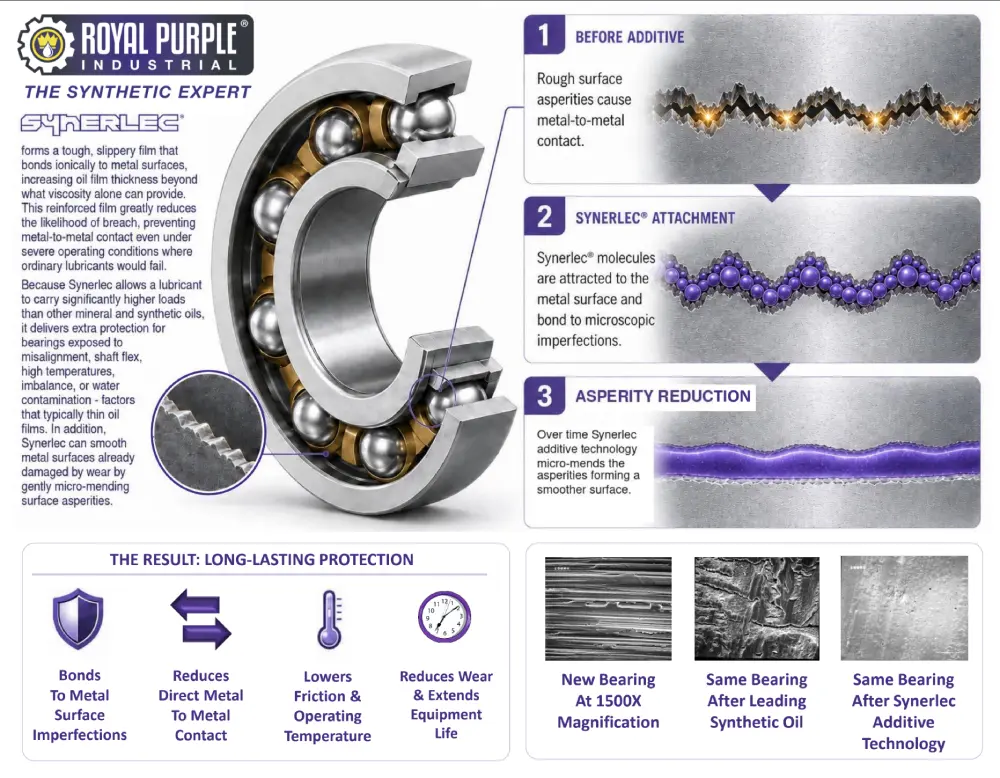
A high-quality synthetic base oil is the foundation, but it is not the whole story. Royal Purple Industrial pairs premium synthetic base stocks with proprietary Synerlec additive technology, which builds a tough, slippery film on metal surfaces and increases film strength well beyond what the base oil delivers on its own. The base oil provides thermal stability, a high viscosity index, and long life; the additive system adds the wear protection, boundary-load capacity, and rust and corrosion resistance that industrial equipment demands. The combination is what separates a good synthetic from a lubricant engineered to outperform both mineral oils and many competing synthetics.
So the synthetic versus mineral decision is not about labels. It is about matching the base oil chemistry, and the additive system built on top of it, to how hard your equipment actually works. Measure the properties, weigh them over the life of the charge rather than the price of the drum, and the choice for demanding applications tends to make itself.
Not sure whether the switch pays off on your equipment? Compare a Royal Purple Industrial synthetic against your current oil, spec by spec and cost by cost. Contact us today to learn more.